
Denelle Dixon interviews Austin Campbell, founder of Zero Knowledge Consulting and NYU Stern professor, on how blockchain fundamentally changes money settlement and financial infrastructure. Campbell argues stablecoins represent a structural upgrade enabling faster velocity and capital efficiency, while real-world asset tokenization only succeeds when it opens access to previously closed markets.
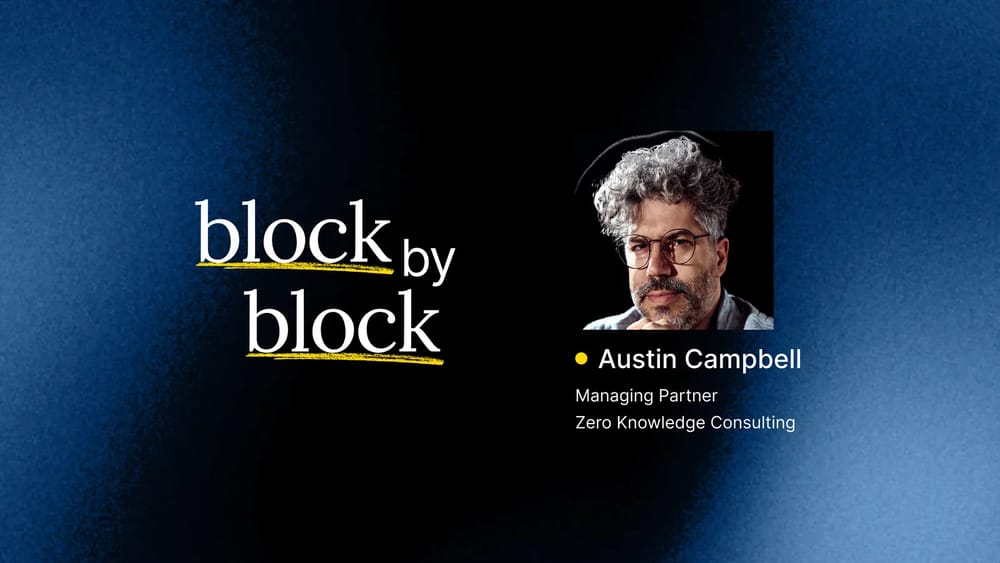
In this Block by Block podcast episode, Denelle Dixon sits down with Austin Campbell, whose background spans traditional finance (JP Morgan, Citi, Paxos) and crypto. Campbell frames the conversation around settlement—the core problem of who goes first in exchange. He explains how stablecoins create a third form of money by separating investment from transfer, enabling higher velocity with less idle capital. On real-world assets, Campbell emphasizes that tokenization alone is meaningless; projects must open access to previously restricted markets (citing Etherfuse's tokenization of non-U.S. sovereign debt as a success). He challenges assumptions about public blockchains being unsuitable for finance, arguing the real constraint is regulatory adoption lag. Campbell predicts 'settlement' will define 2026, as faster, programmable settlement with clear delivery-versus-payment mechanics will simplify financial infrastructure and reduce intermediaries.
