
Why Compliant Privacy Is a Business Requirement for Fintech Companies
Public blockchains enable fast settlement but expose sensitive business data. Regulated payment providers need compliance-ready privacy: transactions confidential by default, auditable on demand. Arcane Finance demonstrates this on Stellar, enabling fintech, stablecoins, payroll, and treasury platforms to use shared settlement rails without publishing volumes, margins, or timing.

On-chain payments have reached a point where fintech teams can treat public blockchains as settlement infrastructure. Stellar is one of the clearer examples: stablecoins, tokenized assets, payroll products, and treasury platforms already use the network for payment and liquidity flows.
The harder question now is whether those flows can support regulated business activity. Fintech companies cannot move serious payment volume on public rails if every transfer exposes counterparties, amounts, timing, and operating patterns. Regulated markets also require identity checks, audit access, and reporting.
That creates the need for compliance-ready privacy: transactions stay confidential by default, while specific data can be disclosed through scoped and auditable workflows when review is required. Arcane Finance is building that privacy and compliance layer on Stellar, so payment companies can use shared settlement rails without exposing sensitive business data by default.
Payment Volume Has Moved the Question From If to How
Stablecoin payment data now supports a practical business conversation. McKinsey's 2026 analysis of stablecoins in payments states that raw stablecoin transfer volume can appear much larger than true payment usage, and it separates genuine payments from trading, exchange flows, and automated activity.
McKinsey estimates about $35 trillion in annualized stablecoin transaction volume and about $390 billion in genuine end-user payment activity — including invoices, remittances, payroll, and card-linked payments — based on December 2025 activity [McKinsey, 2026].
That distinction matters for fintechs. The strongest case for stablecoins does not rest on inflated transfer volume. It rests on the smaller and more useful payment layer where businesses pay suppliers, platforms settle with users, workers receive payroll, and finance teams manage treasury operations.
Chainalysis also frames stablecoins as a growing settlement tool for remittances, B2B payments, treasury operations, and access to dollar-denominated value [Chainalysis, 2026]. These use cases all share the same operational constraint. Businesses want faster settlement and programmable money without turning customer flows, supplier terms, payroll cycles, and treasury strategy into public data.
The on-ramp question has changed. Fintechs are no longer asking only whether public rails can support payments. They are asking how those rails can meet ordinary business requirements for confidentiality, controls, reporting, and risk review.
Public Ledger Risks
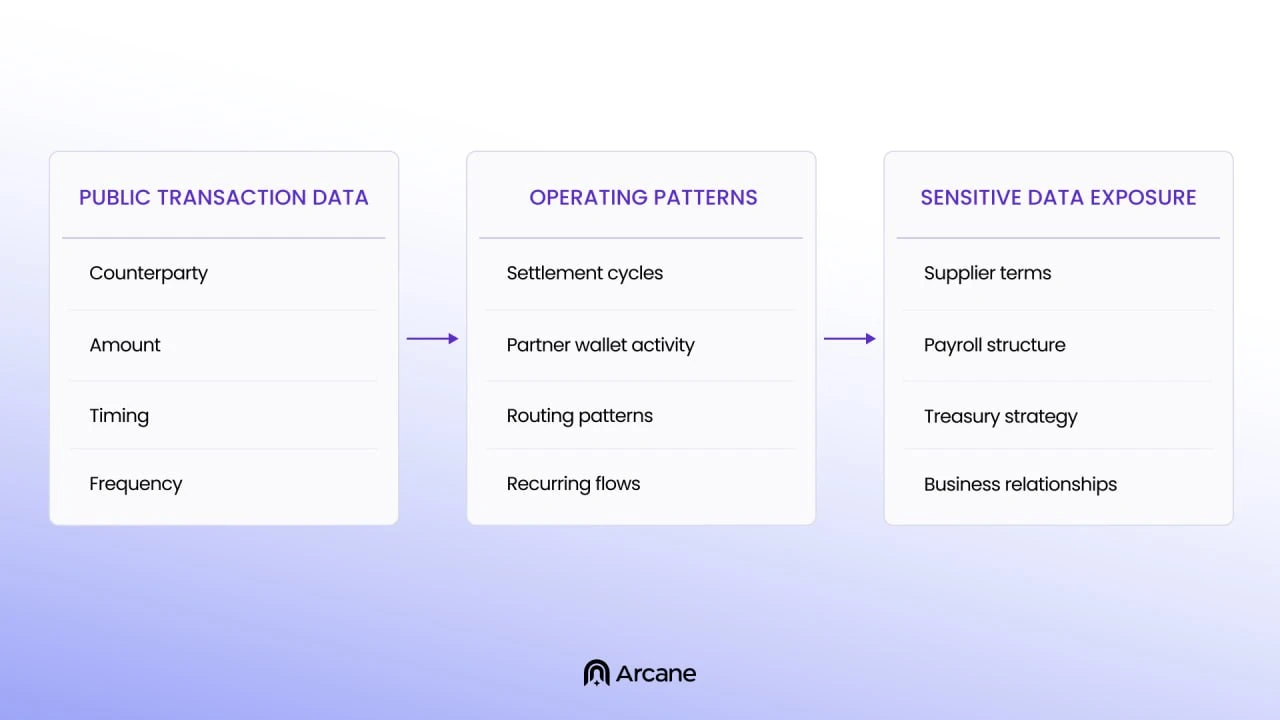
Public blockchains give every observer access to transaction history. That transparency supports verification and open settlement, but it creates a direct commercial liability for companies handling sensitive payments.
- A payment provider can expose merchant settlement cycles, partner wallets, transaction sizes, and routing patterns.
- A stablecoin issuer can expose redemption timing, market-maker activity, and liquidity relationships.
- A payroll platform can expose payment dates and compensation ranges.
- A neobank can expose user behavior if customer wallets become linkable.
- A treasury platform can expose rebalancing schedules, cash positions, and vendor relationships.
In traditional finance, companies protect customer lists, supplier terms, salary files, and treasury processes. Public-chain settlement can reconstruct parts of those records through repeated transaction observation. Even without names, wallet clustering and timing analysis can reveal counterparties, operating cadence, and business structure.
There is also a market-structure cost. Hedera's analysis of MEV for institutional blockchain infrastructure argues that visible transaction ordering can create unacceptable execution risk for regulated finance, because pending or observable activity can be exploited by searchers, bots, or other market participants [Hedera]. MEV estimates vary by methodology, asset type, and time period, so any dollar figure should be treated as an estimate. The business mechanism is clear: visible intent, visible size, and visible timing can create extractive opportunities before or during settlement.
Chainlink's work on confidential assets describes the enterprise problem in similar terms. Public blockchains can reveal asset types, transaction amounts, and counterparties, which limits institutional use cases where commercial confidentiality and compliance are required [Chainlink]. For fintechs, this means privacy is part of the product requirement. A rail that leaks sensitive business activity will struggle to win serious payment volume from enterprises, PSPs, neobanks, and treasury teams.
Anonymous Privacy Fails the Regulated Market
Full public transparency creates a business problem. Full anonymity creates a regulatory problem. Regulated fintechs need identity checks, sanctions controls, transaction monitoring, record retention, tax reporting, and lawful review.
The FATF has set global standards for virtual assets and virtual asset service providers, including requirements aimed at anti-money laundering and counter-terrorist financing controls. FATF's virtual asset materials emphasize regulation, oversight, red-flag indicators, and the need to prevent misuse of virtual assets for illicit finance [FATF]. FATF Recommendation 16, widely known as the Travel Rule in the crypto context, requires virtual asset service providers to collect and transmit required originator and beneficiary information for covered transfers [FATF].
The EU has also built a detailed crypto-asset framework. The European Commission describes MiCA as a harmonized framework covering crypto-asset issuers and crypto-asset service providers, designed to support safer financial services, cross-border activity, and market integrity [European Commission]. For fintechs serving EU clients, MiCA and related AML rules place compliance evidence at the center of market access.
Tax reporting adds another layer. The Council of the European Union adopted DAC8 in 2023 to extend administrative cooperation rules to crypto-assets. DAC8 requires crypto-asset service providers to collect and report information for tax purposes, with the rules applying from 2026 and first reporting exchanges expected after implementation [Council of the EU].
In the United States, the GENIUS Act created a federal framework for payment stablecoins in 2025. Public legislative materials describe permitted payment stablecoin issuers, reserve requirements, disclosures, and oversight obligations [Congress.gov]. Fintech teams should review the statute and implementing guidance directly before relying on specific obligations, but the direction is consistent: payment stablecoins are being pulled into formal financial supervision.
These frameworks point to the same conclusion. Regulated payment activity requires identity, auditability, and reporting. A privacy model for fintech cannot remove those capabilities. It has to make disclosure controlled, limited, and accountable.
Compliance-Ready Privacy Means Scoped Disclosure
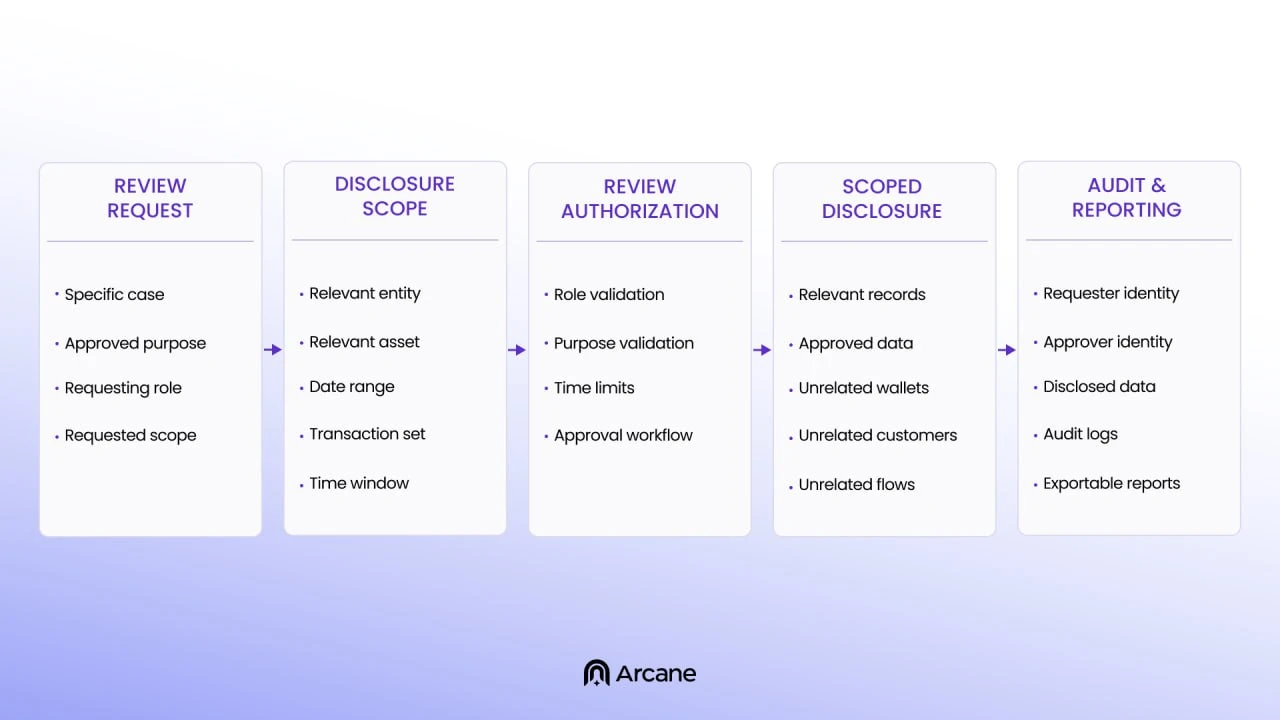
Compliance-ready privacy means private by default and disclosed on demand. Standard payment activity remains confidential to outside observers. Authorized review remains possible through defined roles, approved purposes, time limits, audit logs, and exportable reports.
A compliance officer reviewing a flagged payment should see only the data tied to that case. An auditor reviewing a reporting period should receive only the relevant entity, asset, account, date range, or transaction set. An enterprise customer should have a record of who requested access, who approved it, what data was shown, and why.
This requires more than private transfers. It requires encrypted record indexing, role-based access, approval workflows, disclosure policies, audit trails, and reporting exports. It also requires clear data boundaries, so one review does not open unrelated customer history, unrelated wallets, or unrelated business flows.
A payroll platform shows the requirement clearly. Employees need salary privacy. Finance teams need reconciliation. Auditors may need a defined payroll period. Compliance teams may need a specific transaction record. Compliance-ready privacy allows each group to access the data they are authorized to review without publishing the full payroll graph.
A stablecoin issuer has a similar requirement. Commercial partners may need confidential settlement. Auditors may need records. Regulators may need reporting. Operations teams may need reconciliation. The system has to protect normal payment activity while preserving a review path.
Compliance Creates Business Value
Compliance is often treated as a cost center. For on-chain fintech products, it also functions as a license to operate and scale.
Market access comes first. A fintech that cannot demonstrate Travel Rule alignment, sanctions controls, record retention, and reporting capability faces friction with banks, custodians, PSPs, enterprise buyers, and regulated jurisdictions. Compliance gives those counterparties a basis for integration.
Institutional sales depend on the same evidence. Banks and enterprises ask how records are stored, who can access them, how approvals work, how reports are produced, and how reviews are logged. A product that cannot answer those questions creates procurement risk. A product with scoped disclosure and audit trails gives risk teams a clearer path to approval.
Risk reduction has measurable value. IBM's 2025 Cost of a Data Breach Report places the global average breach cost at $4.44 million and the average financial services breach cost at $5.56 million [IBM, 2025]. IBM also reports regulatory fines as one of the post-breach cost factors tracked in the report [IBM, 2025]. For fintechs, transaction data, identity data, and payment records are sensitive assets. Less unnecessary exposure means less operational risk.
Durability is another business advantage. Regulatory expectations tend to increase as payment volume grows. Products built around uncontrolled anonymous flows face banking, listing, and enforcement pressure. Products built around public transparency face enterprise adoption limits. Compliance-ready privacy gives fintechs a model that can grow with larger clients and stricter review demands.
Privacy Creates Product Value
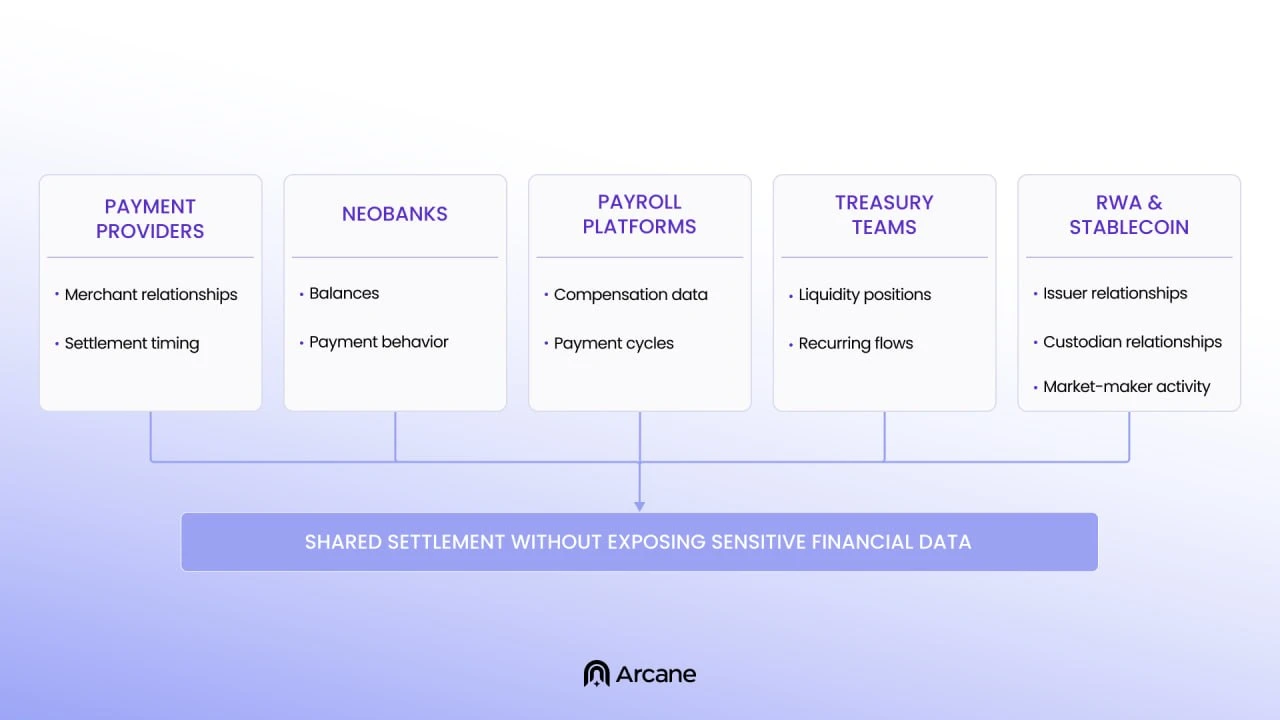
Privacy gives fintechs a stronger product promise. Businesses want settlement speed, lower friction, and programmable money without exposing pricing, margins, counterparties, volumes, and strategy.
- For PSPs, privacy protects merchant relationships and settlement timing.
- For neobanks, it protects balances and payment behavior.
- For payroll platforms, it protects compensation data.
- For treasury teams, it protects liquidity positions and recurring operating flows.
- For RWA and stablecoin platforms, it protects sensitive transfers between issuers, custodians, market makers, and enterprise clients.
Client trust depends on this. A user can accept public-chain verification as a settlement feature. That same user will resist a product that turns financial activity into a public behavioral record. Privacy allows fintechs to offer the benefits of shared settlement without forcing customers to give up ordinary financial confidentiality.
Privacy also improves operational security. Named, recurring, and high-value flows can create targeting signals. Treasury cycles, payroll dates, and large settlement patterns can give attackers useful information. Confidentiality reduces what external observers can learn from watching payment activity.
The product upside reaches beyond risk control. Confidential stablecoin payments, private payroll, controlled treasury settlement, private B2B payment networks, and tokenized asset movement with approved disclosure become easier to build when privacy and compliance sit in the same stack.
The Market Is Already Moving This Way
Large payment and market infrastructure firms are treating privacy-preserving settlement as an institutional requirement.
Visa announced in 2026 that it would bring privacy-preserving payments to Canton Network and become a Canton Super Validator. Visa described the network as infrastructure for financial institutions, with support for private payments, stablecoin settlement, and treasury use cases. It also referenced testing with Brale for private stablecoin settlement [Visa IR, 2026].
The commercial need is direct: banks cannot run payroll with salaries visible to the market, and trading firms cannot expose every position and trade. Shared settlement works for regulated finance only when sensitive data stays inside controlled visibility boundaries.
DTCC has worked on tokenized asset and collateral trials where permissioning and participant-specific visibility matter [DTCC]. Mastercard has extended its crypto and stablecoin settlement work through partner programs focused on regulated connectivity, wallets, and payment network integration [Mastercard].
Chainlink and TRM Labs point in the same direction. Chainlink describes confidential assets as a way to keep enterprise activity private while assets remain verifiable [Chainlink]. TRM Labs argues that privacy and compliance can coexist through lawful access, risk controls, and accountable review [TRM Labs].
Why This Matters for Stellar Builders
Stellar is a natural venue for this discussion because its ecosystem centers on payments, stablecoins, asset issuance, and financial applications. As more financial activity uses public rails, privacy and compliance become product requirements rather than optional infrastructure.
Stellar's technical base has also become more relevant for privacy-preserving applications. Protocol 25, known as X-Ray, introduced host functions for BN254 and Poseidon or Poseidon2, primitives commonly used in zero-knowledge systems [Stellar Developers]. Protocol 26, "Yardstick," continues related work with additional BN254 functions [Stellar Developers]. These upgrades do not make Stellar private by default. They make zero-knowledge applications more practical to build in a network already oriented around financial use cases.
Nethermind's stellar-private-payments project showed how private payment flows can be represented on Stellar using Soroban smart contracts, Circom circuits, Groth16 proofs, Poseidon2 hashing, Merkle trees, commitments, and nullifiers [Nethermind]. Nethermind presents the project as a research prototype, unaudited and unsuitable for production assets. Its value is architectural: it shows that familiar privacy-preserving payment patterns can be expressed on Stellar.
For Stellar-based fintechs, the business requirement remains the same. Privacy primitives can protect transaction details. Production use also needs compliance checks, encrypted records, role-based access, approval flows, audit logs, and reporting.
Where Arcane Fits
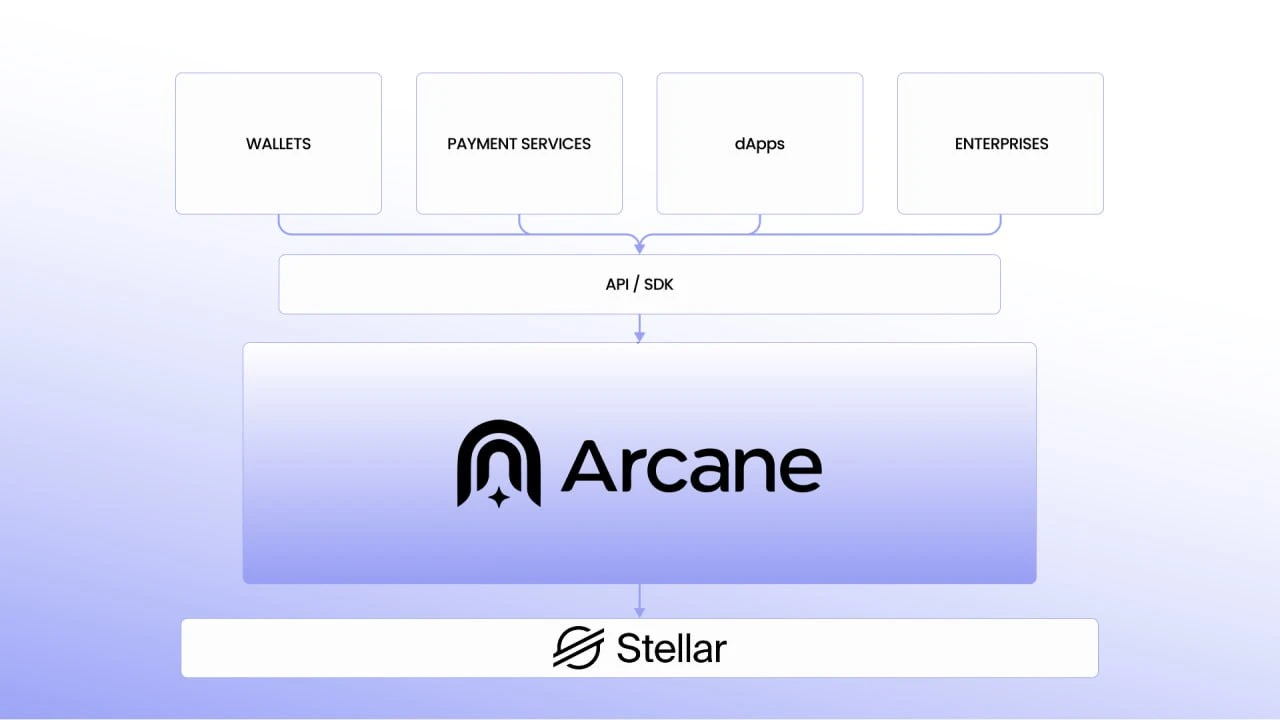
Arcane sits in that operational layer. Privacy primitives such as confidential transfers and shielded balances are necessary, but they are only part of the product stack a regulated fintech needs.
Turning private settlement into deployable infrastructure requires encrypted record indexing, access policies, approval workflows, selective disclosure scoped by role, purpose, and time window, audit logs, and reporting exports. It also requires integration paths through SDKs and APIs, so payment apps, stablecoin issuers, payroll products, and treasury platforms can add privacy without rebuilding the full compliance layer themselves.
That is the practical bridge from cryptographic capability to financial infrastructure. A fintech does not need privacy as a slogan. It needs a system that protects business data, supports regulated review, and fits into daily operations. For a fuller picture of this model, see "From ZK Primitives to Production Financial Infrastructure," the Arcane Compliance Layer, and Arcane Private Transfers.
Disclosure: Arcane Finance contributed to this article and is building compliance infrastructure for privacy-preserving financial applications.
Conclusion
Fintech companies need confidentiality for customers, counterparties, payroll, treasury, and settlement flows. They also need compliance controls for identity, monitoring, audits, and reporting.
Public transparency exposes too much business activity. Anonymous privacy gives regulated teams too few controls. Compliance-ready privacy gives fintechs the model they need: confidential by default, disclosed through scoped, permissioned, and auditable workflows when review is required.
For payment providers, stablecoin issuers, neobanks, payroll platforms, treasury products, and tokenized asset teams, privacy with compliance is becoming a precondition for meaningful payment volume on public rails.
Sources and Further Reading
- McKinsey, "Stablecoins in payments: What the raw transaction numbers miss," 2026: https://www.mckinsey.com/industries/financial-services/our-insights/stablecoins-in-payments-what-the-raw-transaction-numbers-miss
- Chainalysis, "Stablecoin Utility and the Future of Payments": https://www.chainalysis.com/blog/stablecoin-utility-future-of-payments/
- FATF, "Virtual Assets": https://www.fatf-gafi.org/en/publications/Virtualassets/Virtual-assets.html
- FATF, Recommendation 16 and Travel Rule materials: https://www.fatf-gafi.org
- European Commission, "Crypto-assets": https://finance.ec.europa.eu/digital-finance/crypto-assets_en
- Council of the European Union, DAC8 adoption: https://www.consilium.europa.eu/en/press/press-releases/2023/10/17/taxation-council-adopts-new-rules-on-administrative-cooperation-dac8/
- Congress.gov, GENIUS Act materials: https://www.congress.gov
- IBM, "Cost of a Data Breach Report 2025": https://www.ibm.com/reports/data-breach
- Hedera, "Why MEV-resistance is not optional for institutional blockchain infrastructure": https://hedera.com/blog/why-mev-resistance-is-not-optional-for-institutional-blockchain-infrastructure
- Visa IR, "Visa to Bring Privacy-Preserving Payments to Canton Network," 2026: https://investor.visa.com/news/news-details/2026/Visa-to-Bring-Privacy-Preserving-Payments-to-Canton-Network/default.aspx
- Chainlink, "Confidential Assets: Enterprise Privacy on Public Blockchains": https://chain.link/article/confidential-assets-enterprise-privacy
- TRM Labs, "On-chain Privacy and Financial Compliance": https://www.trmlabs.com/reports-and-whitepapers/on-chain-privacy-and-financial-compliance
- Stellar Developers documentation: https://developers.stellar.org
- Nethermind Privacy Engineering, stellar-private-payments: https://github.com/NethermindEth/stellar-private-payments
- Mastercard crypto and stablecoin materials: https://www.mastercard.com
- DTCC tokenization and digital assets materials: https://www.dtcc.com
