Stellar and RWAs
Stellar's 2014 anchor model was built for regulated token issuance. A decade later, with $3B+ in RWAs and DTCC integrating Wall Street's clearinghouse, that design is validating as the infrastructure for institutional blockchain finance.
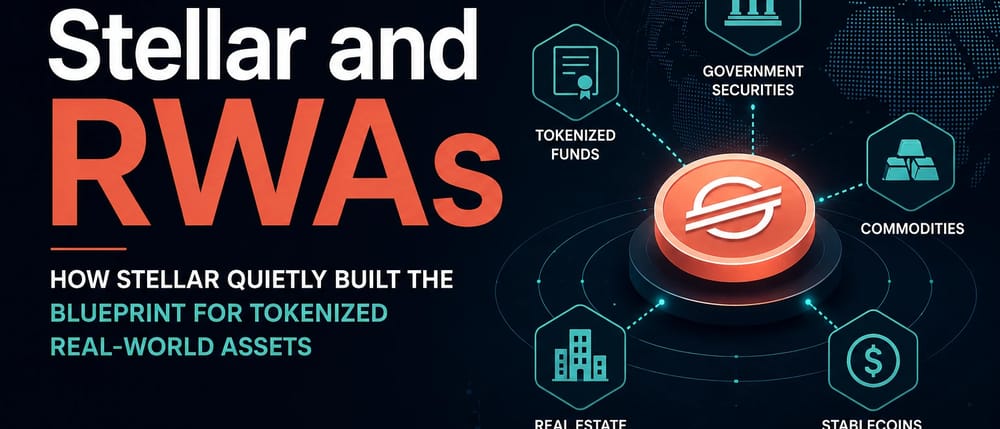
Before "Stablecoin" Was a Buzzword: How Stellar Quietly Built the Blueprint for Tokenized Real-World Assets
When people talk about the tokenization boom, the conversation almost always starts with Ethereum, BlackRock's BUIDL, or the GENIUS Act. What tends to get skipped is that one blockchain was doing this before the vocabulary even existed. Stellar wasn't built to chase a trend — it was built in 2014 around the idea that any currency or asset should be able to move like an email. That founding idea, unglamorous as it sounds, turned out to be exactly the architecture the tokenized real-world asset (RWA) industry needed a decade later.
The Anchor Model: Stablecoins Before They Had a Name
Stellar's core design has always revolved around "anchors" — regulated entities, typically banks or financial institutions, that hold real-world deposits and issue a corresponding digital token on the network representing that value. An anchor in the Philippines could issue a peso-backed token; a European anchor could issue a euro-backed one; and Stellar's built-in decentralized exchange let those tokens swap directly, with the network's native asset, XLM, acting as a bridge currency when a direct market didn't exist.
This is, in essence, the stablecoin model — except Stellar was running it years before "stablecoin" became industry shorthand. As early as 2015, Stellar partnered with African microfinance platforms and mobile money providers to move fiat-backed value across borders. By 2017, IBM had partnered with Stellar to build World Wire, a cross-border payments network explicitly designed around bank-issued, fiat-backed tokens. When IBM signed six international banks in 2019 to issue tokens backed by their national currencies on World Wire, the press release used the word "stablecoin" — but conceptually, Stellar's anchors had been doing this work since the network's earliest days. Stronghold's FDIC-insured USD token, launched on Stellar with IBM's backing in 2018, was one of several early attempts to bring bank-grade trust to an on-chain dollar, well before Circle's USDC or Tether's growth into the multi-hundred-billion-dollar instrument it is today.
The point isn't that Stellar invented the stablecoin — Tether predates it. The point is that Stellar built general-purpose infrastructure for any regulated, fiat-backed token to move globally, and stablecoins turned out to be the first major application of that infrastructure. Everything that followed in tokenized real-world assets was really just an extension of the same anchor logic: take something with real-world value, represent it faithfully on-chain, and let it move at internet speed.
Franklin Templeton: The First Regulated Fund to Live on a Public Blockchain
If the anchor model was Stellar's proof of concept for tokenized cash, Franklin Templeton's Franklin OnChain U.S. Government Money Fund (FOBXX) was its proof of concept for tokenized securities. Launched in April 2021 — years before "RWA" became a category institutions actively competed in — FOBXX became the first U.S.-registered mutual fund to use a public blockchain as its official system of record for transactions and share ownership.
Represented by the BENJI token, the fund let investors hold shares of a government money market fund directly through blockchain-integrated wallets, with yield accruing and reflecting in balances continuously throughout the day, rather than the monthly cadence typical of traditional money market funds. Franklin Templeton built the tokenization technology in-house and worked directly with the SEC to demonstrate that a public blockchain could meet the security and validation standards regulators required. It wasn't a sandbox experiment; it was a live, regulated '40 Act fund, doing something no fund had done before.
That early conviction has aged well. Five years on, BENJI has expanded across nine blockchains — including Ethereum, Solana, and Polygon — but Stellar remains its anchor in every sense: roughly 95% of BENJI's holder base still sits on Stellar, and the fund recently earned an "AAAm" Principal Stability Fund Rating from S&P Global Ratings, the highest available for money market funds. Franklin Templeton's own Head of Digital Assets put it plainly: the industry has spent years racing to catch up to what they built on Stellar in 2021.
What the Numbers Look Like Today
According to rwa.xyz's live Stellar network data, the network currently hosts:
- ~$3.01 billion in distributed real-world asset value
- $78.64 million in "represented" asset value
- 70 distinct RWA products
- ~19,290 RWA holders — up over 14% in the past 30 days
The platform leaderboard tells its own story about how the ecosystem has matured beyond Franklin Templeton alone.
| Rank | Platform | Value on Stellar |
|---|---|---|
| 1 | Spiko | $1.2B (9 products, 37%+ of network total) |
| 2 | Franklin Templeton (Benji Investments) | $605.1M |
| 3 | Ondo | $532.1M |
| 4 | Realiz | $500.0M |
| 5 | Circle | $277.5M |
| 6–10 | WisdomTree, Figure, Rivool Finance, Centrifuge, Etherfuse | — |
Layer in Stellar's stablecoin activity — a $334.87 million stablecoin market cap and $5.53 billion in 30-day stablecoin transfer volume — and the picture is of a network where the "anchor" concept has scaled from a niche cross-border payments tool into genuine institutional infrastructure.
The Next Chapter: DTCC Brings Wall Street's Plumbing On-Chain
The clearest signal that Stellar has moved from early mover to core infrastructure came in May 2026, when the Depository Trust & Clearing Corporation (DTCC) — the clearinghouse behind the custody and settlement of more than $114 trillion in U.S. securities — announced plans to connect its tokenization platform to Stellar, with availability targeted for the first half of 2027.
The collaboration builds on a December 2025 SEC no-action letter that authorized DTC, DTCC's depository subsidiary, to tokenize a defined set of custodied assets, including Russell 1000 stocks, ETFs, and U.S. Treasuries. Under the arrangement, DTC retains the authoritative legal "golden record" of ownership, while Stellar hosts a synchronized, tokenized representation of the same assets — enabling faster settlement, extended trading hours, and greater collateral mobility without sacrificing the investor protections that come with traditional custody.
DTCC's Nadine Chakar, Global Head of Digital Assets, pointed directly to Stellar's institutional track record — its compliance-minded architecture, transaction throughput, and low-cost operations — as deciding factors. It's a notable vote of confidence: the most systemically important post-trade infrastructure in U.S. capital markets choosing, as one of its first public blockchain partners, the same network that quietly pioneered fiat-backed tokens back when nobody was calling them stablecoins yet.
The Throughline
Stellar's story in RWAs isn't really a pivot — it's a straight line. A network built to move fiat value across borders became the network banks used to experiment with tokenized dollars before the term existed. That same infrastructure became the foundation for the first regulated tokenized mutual fund. And now it's becoming a settlement layer that Wall Street's central clearinghouse trusts with trillions in custodied securities. If the RWA industry is racing to catch up to Stellar, as Franklin Templeton's team suggested, 2027 may be the year that race gets a lot more crowded — on a track Stellar has effectively worked on for a decade.
I for one am extremely interested in what the next 6–12 months will bring for Stellar and the RWA space.