Stellar celebrated its first anniversary, growing from two cofounders to a 16-person team while launching the Stellar Consensus Protocol, building global partnerships, and establishing a thriving developer community across multiple continents.
DeFi, payments, tokenization, Soroban, governance, and project launches — curated daily from publications, project blogs, and community channels across the Stellar blockchain ecosystem.
Stellar celebrated its first anniversary, growing from two cofounders to a 16-person team while launching the Stellar Consensus Protocol, building global partnerships, and establishing a thriving developer community across multiple continents.
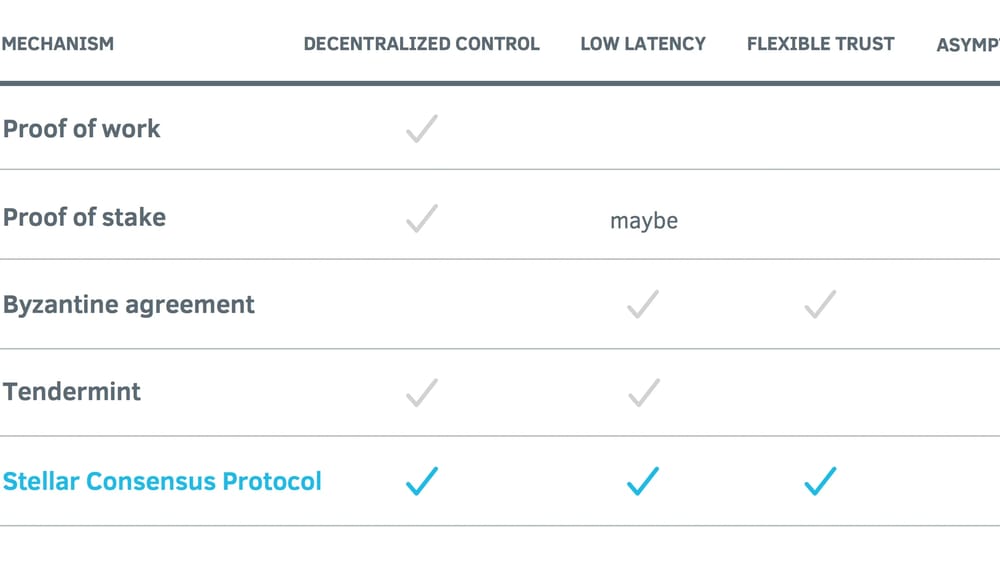
The Stellar Consensus Protocol (SCP) introduces federated Byzantine agreement, a consensus mechanism that achieves decentralized control, low latency, flexible trust, and asymptotic security simultaneously. SCP enables a worldwide financial network where participants reach agreement without relying on centralized institutions.
The Stellar Foundation released details on its new Stellar Consensus Protocol, based on federated Byzantine agreement, designed to replace the existing consensus mechanism. The protocol has been stress-tested to handle 100 million accounts and hundreds of transactions per second, with deployment targeted for summer.
Stellar.org introduces the Stellar Consensus Protocol (SCP), a federated Byzantine agreement mechanism designed for decentralized payments. SCP offers four key properties: decentralized control, low latency, flexible trust, and asymptotic security, with a new open-source codebase now available for peer review.
Stellar co-founder Joyce Kim discusses the project's launch challenges, consensus protocol issues being addressed by Chief Scientist David Mazières, and efforts to drive developer adoption and financial inclusion in emerging markets like Nicaragua and Vietnam.
A ledger fork in the Stellar network sparked debate over the Ripple consensus protocol's safety. Stellar Development Foundation attributed the incident to protocol flaws, while Ripple Labs disputed the claims, arguing the issue stemmed from Stellar's modifications to the code.
Stellar experienced a ledger fork due to weaknesses in its Ripple-based consensus algorithm. The network temporarily switched to a single validator node and is prioritizing development of a new provably correct consensus system to prevent future forks and double-spend risks.
Stellar network experienced a 16-hour outage on September 20, 2014, caused by validator nodes running out of RAM, halting consensus and all transactions. The foundation addressed communication gaps and began work on scalability improvements to prevent recurrence.