
The article argues that maximum decentralization doesn't guarantee better governance. Using data from Stellar Community Fund's Neural Quorum Governance, the author demonstrates that an optimal "sweet spot" exists—one that balances community representation with decision-making efficiency.
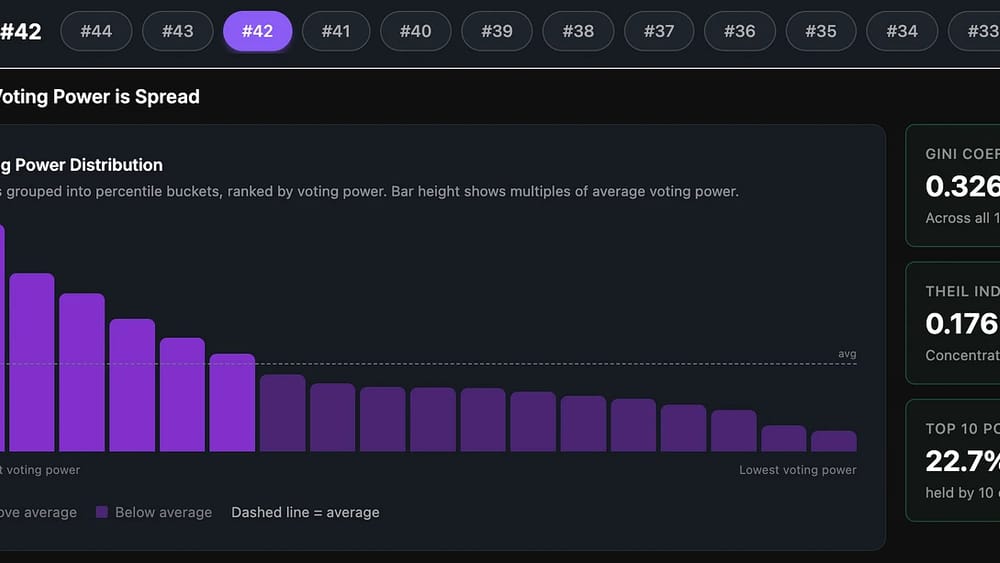
Web3 communities often assume total decentralization is optimal, but governance data from Stellar Community Fund shows otherwise. The author explores four ways to measure decentralization—Gini coefficient, Theil index, Top-N share, and Nakamoto coefficient—and argues the best systems aren't maximally decentralized. Instead, they feature an emergent steering core with earned reputation. SCF's Neural Quorum Governance achieved this through reputation-based voting power across four neurons: assigned roles, trust graphs, voting history, and retro vote quality. Over 15 rounds, the system maintained a Theil index between 0.10 and 0.25, with top-5 vote share steady around 12–13%, while new member onboarding stayed open and merit-based. The key insight: governance systems need both fluid entry and decay mechanisms to stay healthy.
