The Stellar Development Foundation released its Q1 2020 quarterly report, highlighting Horizon 1.0 release, regulatory advocacy efforts, and the first enterprise fund investment in DSTOQ, a fintech company serving emerging markets.

DeFi, payments, tokenization, Soroban, governance, and project launches — curated daily from publications, project blogs, and community channels across the Stellar blockchain ecosystem.
The Stellar Development Foundation released its Q1 2020 quarterly report, highlighting Horizon 1.0 release, regulatory advocacy efforts, and the first enterprise fund investment in DSTOQ, a fintech company serving emerging markets.

SEP-29 enables exchanges and wallets to solve the "forgotten memo" problem on Stellar. Exchanges can now require memos by setting a simple data entry flag, while wallets upgraded to the latest SDK will automatically prevent memo-less payments to those addresses.
Horizon 1.0, Stellar's open-source API, launches with a new ingestion engine that makes queries faster, more consistent, and less dependent on Stellar-Core. The major release includes breaking changes and new endpoints for asset trustlines, multi-sig account discovery, and network-wide offer filtering.
Multisig account transactions involve complex threshold matching across signers and operations. Stellar Expert's tx-signers-inspector library automatically discovers eligible signers, calculates required thresholds, and detects excessive signatures—turning manual verification into a few API calls.
Stellar Development Foundation revamped Stellar.org with a new project directory, updated SDF mandate detailing treasury deployment, and lumen supply metrics documentation to improve ecosystem transparency and support for builders.
Stellar.org's new homepage features runnable code samples for network features like payments and asset issuance. To handle testnet resets every 3 months, the team built an automated script that checks for account existence and recreates necessary accounts, plus a function to return unused testnet lumens to Friendbot to prevent resource depletion.
Stellar Expert deployed three full validators in 2019 forming a fault-tolerant quorum set with open history archives. The contribution supported network decentralization as the validator ecosystem expanded significantly that year.
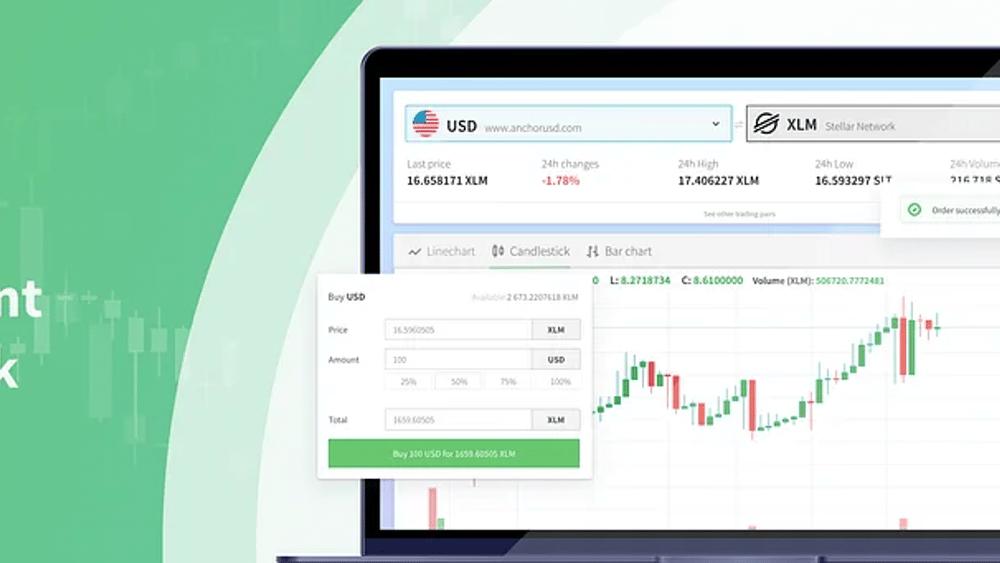
StellarTerm is an open-source trading client for the Stellar Decentralized Exchange (SDEX) with local key storage for enhanced security. It offers instant login via secret key, Ledger hardware wallet support, multisig accounts, and advanced trading features like real-time charts and notifications. Desktop apps are available for Windows, macOS, and Linux.
Stellar Expert launches an independent blog and announces multiple platform enhancements: markets dashboard aggregating all Stellar trading pairs, SEP compliance scoring for assets, full-text search, and an open API for asset supply data.
Gauntlet announced partnerships with Stellar, Celo, and Compound to provide consulting and stress-testing services. The firm will help Stellar prevent network disruptions, assist Compound with market risk modeling, and support Celo's stablecoin stability mechanisms.
Stellar released Horizon v0.22.1 with support for Stellar-core v12.0.0, introducing a new path_payment_strict_send operation and disabling the inflation mechanism. The release includes updates across all major SDKs and establishes a timeline for testnet upgrade on 10/14 and public network validator vote on 10/28.
Stellar-core v12.0.0 and Horizon v0.21.0 have been released with significant protocol upgrades. The core release implements three Core Advancement Proposals including PATH_PAYMENT_STRICT_SEND, bucket list optimizations, and inflation mechanism disabling, with a validator vote scheduled for October 28th.
Centaurus is a decentralized second-layer solution for Stellar that handles 10,000+ transactions per second with instant confirmation and zero fees. Clusters operate as constellations of independent validator nodes using multisig vaults, enabling high-throughput settlement for remittance networks, CBDCs, and consumer applications without sacrificing Stellar's security model.
Stellar Development Foundation released Horizon v0.20.1 with a new ingestion system that addresses architectural issues by building a full copy of ledger state from history archives instead of relying on Stellar-Core's database. The update enables new features like "Accounts for Signers" and significantly improves path-finding performance by up to 10x.
Stellar Development Foundation launched a redesigned stellar.org website featuring improved developer tools, clearer messaging about the network's capabilities in asset issuance and payments, and a new interactive Runkit for getting started.
Stellar's Decentralized Exchange faces a liquidity problem that market makers can solve. The SDF built Kelp, a free open-source trading bot in Golang that automates market-making strategies on Stellar's DEX and centralized exchanges, with v1.7.1 now available.
CAP draft proposes disabling Stellar's inflation mechanism, which was designed to fund ecosystem projects but now primarily generates validator load through inflation pool payouts.
Stellar Development Foundation released stellar-core v11.2 with automatic quorum configuration and a quorum intersection checker to help validators manage Byzantine Agreement Systems more easily and safely.
Stellar Development Foundation's new leadership outlines five strategic priorities: achieving financial inclusion through technology focus, building products that prove Stellar's value, engaging on policy matters, and increasing communication. SDF is launching a dollar savings app for Latin America and hosting its first Meridian conference in Mexico City.
Stellar public network Protocol 11 upgrade scheduled for June 10, 2019 at 1600 UTC. Developers must upgrade SDKs, Horizon instances, and Stellar Core to ensure compatibility.
On May 15th, the Stellar network halted for 67 minutes due to consensus failure, but the ledger state remained safe and consistent. The outage revealed the need for better validator monitoring, faster restart procedures, and improved community standards around validator maintenance and configuration.
The Stellar Development Foundation announced a new ticker API providing real-time market data about assets, markets, and issuers on the Stellar Network. The API offers enhanced functionality including OHLC values, orderbook statistics, and a GraphQL interface, with the previous SDF-hosted ticker instance decommissioned on January 3, 2024.
Stellar Development Foundation announces ZkVM, an experimental zero-knowledge virtual machine for scalable and confidential smart contracts. The research explores sidechain architectures to enhance Stellar with privacy features and flexible contract capabilities.
The Stellar Development Foundation announces the release of a new Go SDK for the Stellar network, featuring horizonclient for Horizon server access and txnbuild for transaction construction. This is the third official SDK alongside JavaScript and Java, designed with Go-specific idioms and improved developer experience.
Stellar's built-in Data Entries feature limits metadata storage to 128 bytes per chunk and creates permanent blockchain bloat. Stellar Expert analyzes three approaches to off-chain account metadata: REST API endpoints, distributed hash table references, and a dedicated metadata service, weighing trade-offs between decentralization, scalability, and protocol change requirements.
The Stellar Development Foundation announces a new roadmap organizing 2019 projects across five teams: Horizon, Stellar Core, Product, Ecosystem, and Organization. The roadmap will eventually become a living document tracking progress on multiple initiatives.
SDF announces the Stellar Developer Program, replacing the Build Challenge format with monthly funding for long-term projects, plus new wallet guidelines and a developer mailing list to improve ecosystem collaboration.
Stellar Expert uncovered a critical DEX matching engine vulnerability that allowed attackers to buy any asset at 1:1 rates via dust-sized trades. Attack potential reached 16,000 XLM per hour with 50 automated accounts. The vulnerability was responsibly disclosed to SDF and fixed in Stellar Core v10; all ecosystem funds remained secure.
StellarExpert November 2018 update adds asset search by code name, displays account lock status and authorization flags for security insights, improves federation reverse lookup support, and separates offer management from executed trades in the Stellar network explorer.